Not-So-Merry Mount
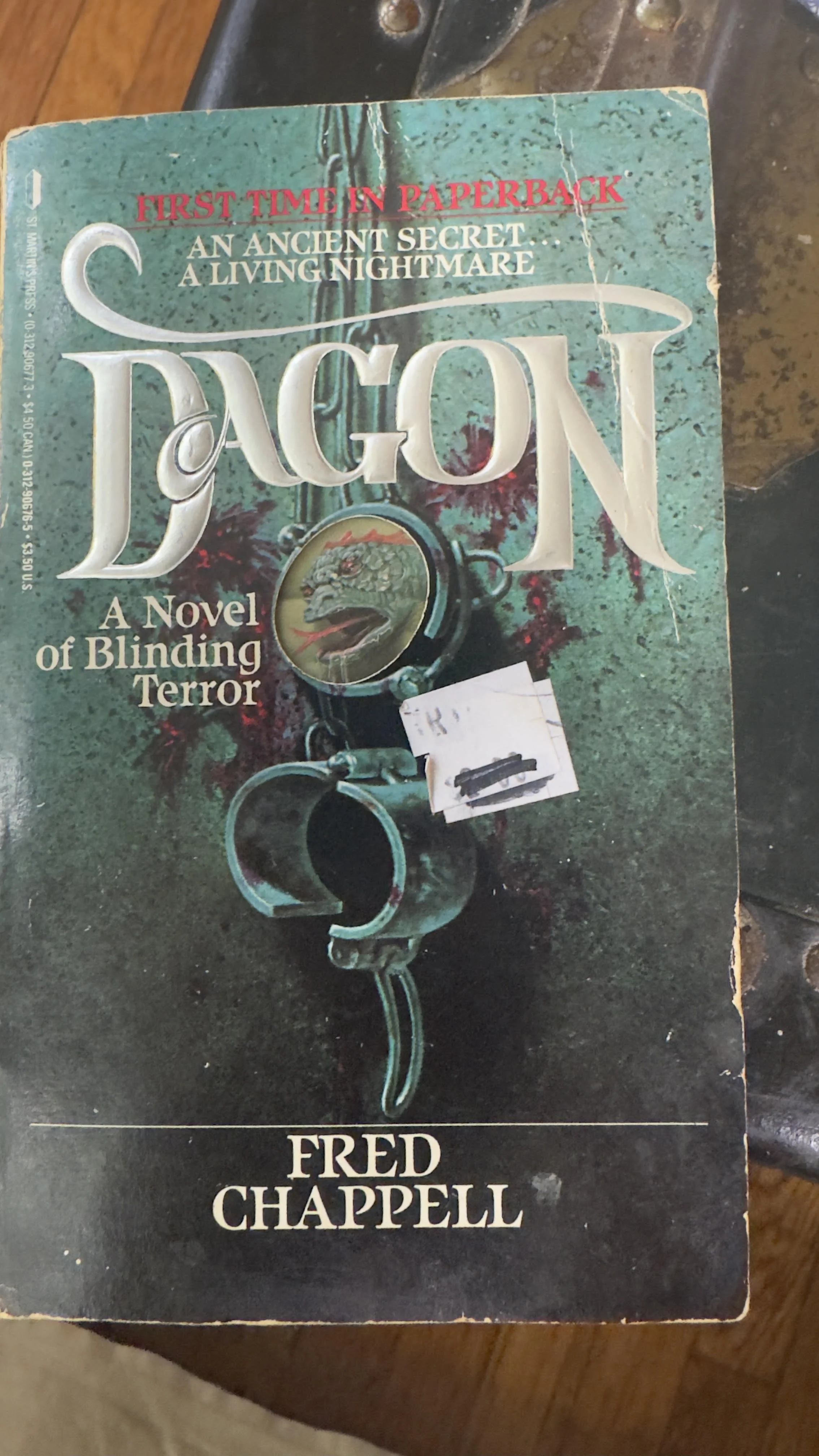
Note: Usual bibliographic/condition info not included because I’m holding on to this gem! Of course, if you’re interested…
Found this oddity in amongst a box of otherwise unremarkable paperbacks (think stuff like outdated self help ripoffs and Rosamund Pilcher). I’ve spent years devouring everything “weird horror” and Lovecraftian (and as a kid in the eighties devouring the prodigious output of every half assed publisher trying to get in on the horror boom) but had never come across Fred Chappell.
The only copyright information inside “Dagon” reads 1968, but based on the cover art this is clearly a reprint, probably released in the 80s as part of the cash grab following Stephen King’s thundering bestsellers. The cover and back blurb make the book sound like standard schlock horror fare. Fans of Lovecraft can’t fail to know Dagon, of course, and the back blurb uses enough generalities (unspeakable horror, etc.) that the unwary reader can be forgiven for being surprised at the actual book.
It starts out predictably enough. A somewhat intense, overeducated Protestant minister somewhere in the American south, Peter Leland, and his lovely, bubbly blonde wife Sheila find that Peter has inherited his family’s ancestral farm somewhere in the more rural south. This seems like the opportunity the couple has been looking for—a retreat where Peter can write the book he’s been mulling over for some time.
Peter fancies himself a theologian and has become fascinated by a connection he perceives between two different legends. The first is the story of the destruction of the idolatrous god Dagon from the Bible.
The second story is the tale of Merry Mount, in which a sect of puritans in colonial Massachusetts went off the reservation, so to speak, erecting a maypole and having delightful sex with each other and the local natives. (I was only familiar with the version of this tale as told by Hawthorne: https://en.wikipedia.org/wiki/The_May-Pole_of_Merry_Mount. Evidently the tale is an old one, though, and much revisited by early American writers: https://www.americanheritage.com/maypole-merry-mount
After the Puritans raided Merry Mount, the town was renamed Mount Dagon—leading Leland to connect the two stories in his head, and leading to his book idea.
“Dagon” should have proceeded predictably from there—a family curse, worship of dark gods, a house whose angles simply don’t add up, a frightened wife, etc.
But this isn’t New England, folks. This is the rural south. We’re in Michael McDowell territory here and don’t you forget it. “Dagon” is written in two parts, and by the end of part one, we’ve taken a hard turn for the redneck Southern gothic—complete with geeks biting the heads off chickens, lovingly-described shotgun shacks, corn liquor by the barrelful, and the worship of obscene gods on half-assed altars made from sawhorses and rotten pine wood.
I didn’t know Chappell at all before finding this extraordinarily weird (in the classic sense) novel, and I haven’t looked him up for the purposes of this post. I plan to chase him down and see if any of his other work is available online. But nothing really beats finding an old yellowed paperback like this. The experience of reading a horror novel is inexplicably changed on an e-reader. Maybe it’s just my age showing. At any rate, keep an eye out for “Dagon” by Fred Chappell. (But only if you have a strong stomach.)
Follow-up
Fred Chappell was a poet and academic from North Carolina and only recently died: https://en.wikipedia.org/wiki/Fred_Chappell
Dagon is certainly more writerly than most books of its genre—I caught shades of Aickman as well as McDowell, but that may just be because I’m re-reading Aickman right now. At any rate, don’t pass this one up if you’re a fan of Southern high strangeness. It’s like the nightmares of Eudora Welty on a meth binge.