Mencken: Jester/Skeptic
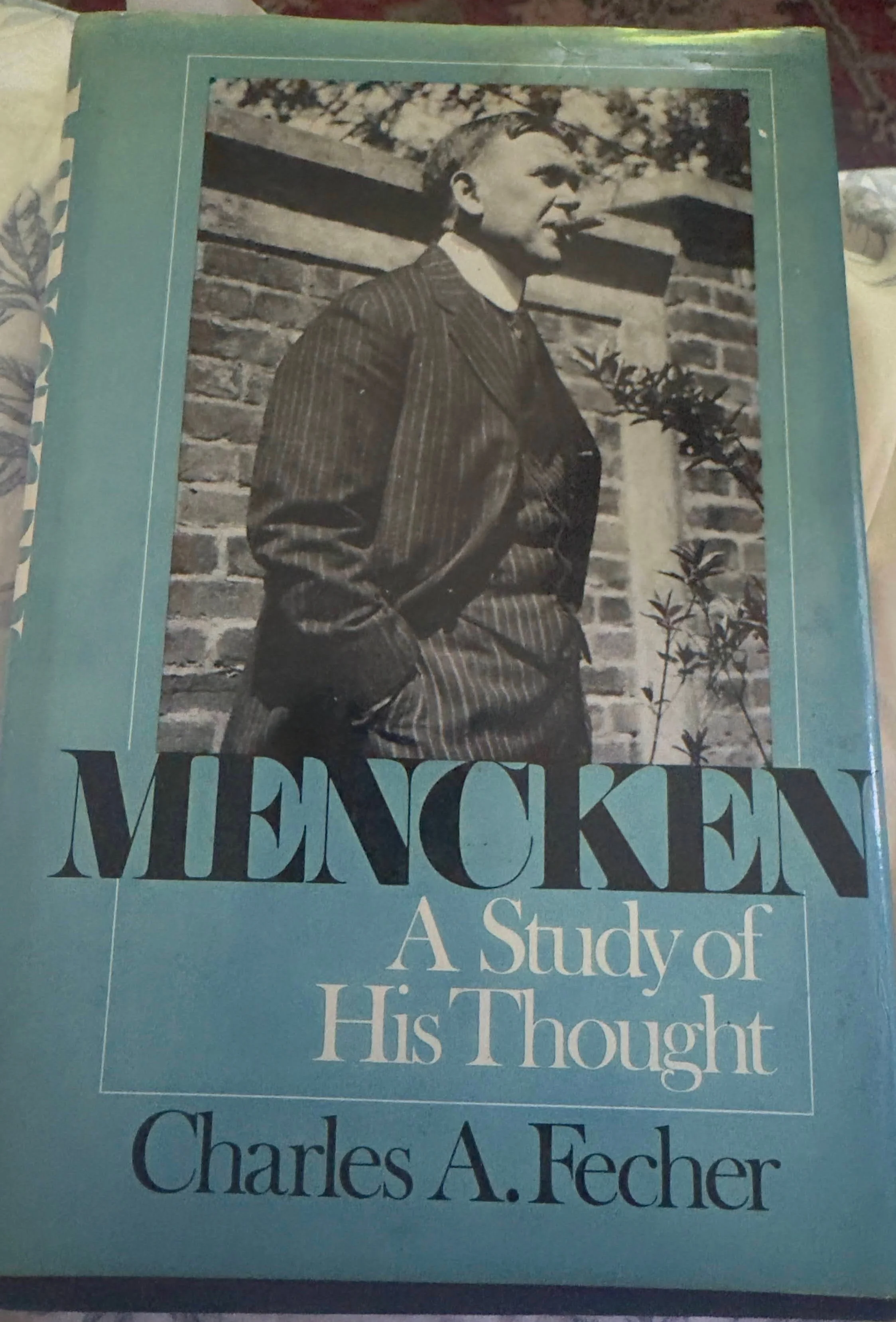
Mencken: a study of his thought
Charles A. Fecher
1978 first edition with DJ, very good to near fine.
Foreword by Alfred A. Knopf.
The real problem with Henry Mencken Is his complacency.
It would be (at best) churlish of me to reprimand anyone for a having had a happy childhood among loving people. At the same time, it’s a fact that most of us don’t grow up in peaceful, prosperous times, much less and age into a society like the one HL Mencken describes in his three famous autobiographies (from which Fecher tales much background on the man, the writer and his thought).
Mencken’s self-professed happiness has long been a thorn in my side as a reader and admirer. Who, after all, was this white, prosperous German man to appoint himself the accountant of America’s many sins?
At the same time, he was quite good at the job he’d created for himself: half court jester, half fuming skeptic. I think we can all agree that someone needed to point out the idiocy of the scopes monkey trial and Mencken did the job that probably to other reporter of the time could have done.
I won’t quote Mencken here (though I’ve saved many of his quotes). After all, he’s a quotable guy and anyone can look up his observations on the American scene.
The point is that Mencken was a great writer. (And I’ll fight anyone who challenges that proposition!)
Highly stylized? Sure. But man, could he puncture buffoons with a short, sharp sentence. His observations, furthermore, remain relevant and trenchant to this day, some 80 years or more after his death. He wrote like Hemingway if Hemingway had turned his gaze towards America vs down his own pants.
He wrote like a newspaper man on the city desk whose ribbon was running dry. He wrote like an original. He wrote real good, and anyone who disagrees, like I said, we can take it outside.
But his blind spots were big, and they were numerous. In later days HLM has been called a racist, a neo-fascist, and a true right winger. I disagree. He was simply, and quite terribly, spoiled. The eldest son of a privileged family, he couldn’t see beyond his own Hollins Street backyard to even try to grasp the situation of the Black people in his beloved Baltimore. He was born into privilege and he came up through privilege, he was the right man at the right time. The man suffered not a whit until his last days.
Again, I am a huge admirer of Mencken and will defend his writing forever. His insight was limited but when he got it—well, the test of time has in many cases proven he was right. And he remains an entertaining read, which—you know, it matters!